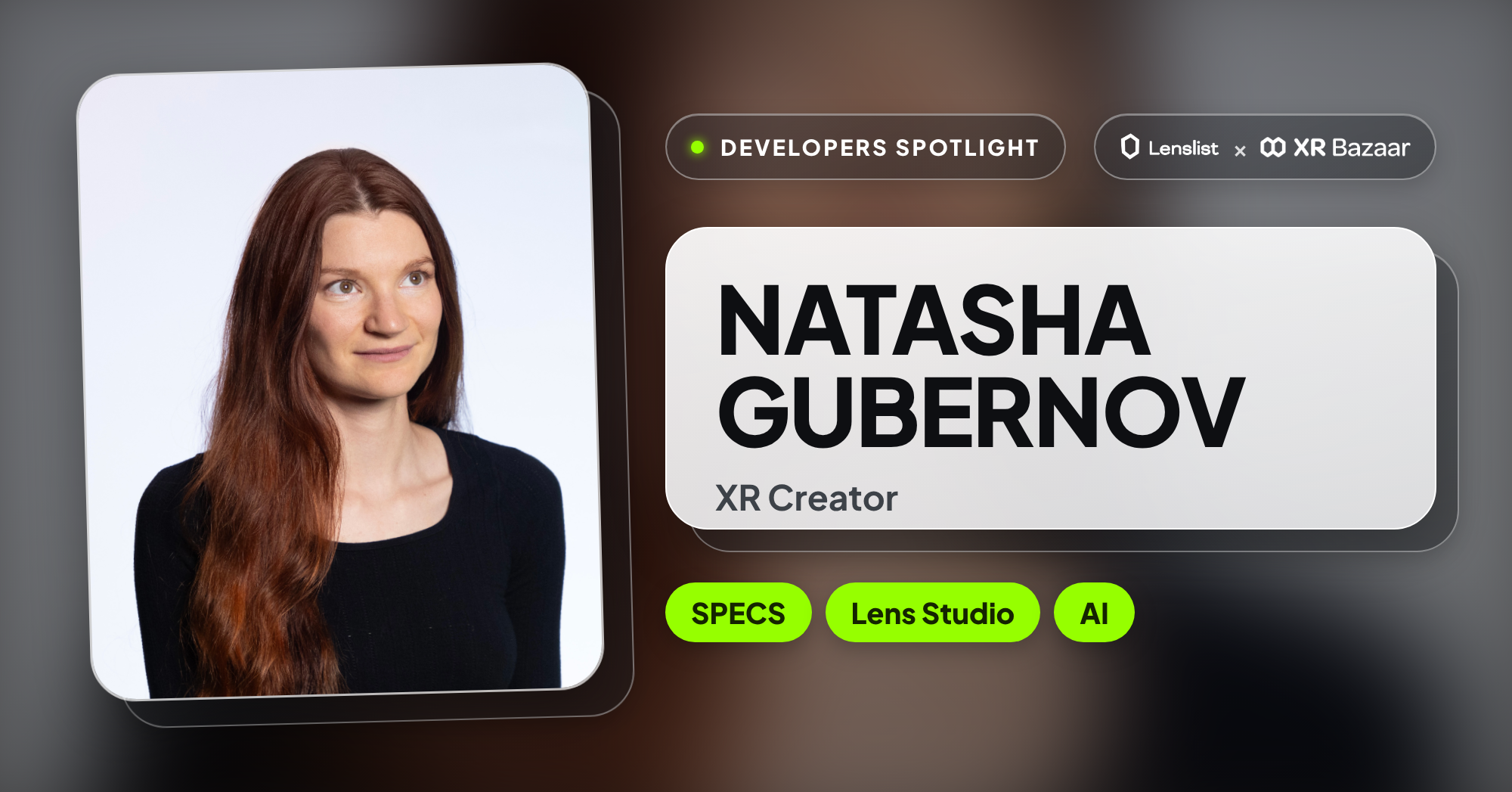
Developer Spotlight: Natasha Gubernov on Traditional Art Meeting SPECS
Technology isn’t the enemy of art. Each new platform can become another tool for self-expression, giving artists ways to reach wider audiences, share their ideas, and explore new possibilities. Smart glasses bring those possibilities into the physical world, supporting the creative process and complementing the tools artists already use.
For Natasha Gubernov, a developer and artist, that connection became the starting point for ArtGuide, which she created for the Spectacles Community Challenge.
Drawing on her own experience with watercolor and abstract painting, she built a tool that places visual references directly over paper or canvas, helping artists explore composition without leaving marks on the surface.
We spoke with Natasha about her experience building ArtGuide, how her background in both art and development shaped the project, and where she sees opportunities for smart glasses to support creative practice and learning.
Explore her work and hear her perspective on bringing art and technology together.
After building ArtGuide, where do you see the biggest untapped opportunity for AR glasses developers?
I think one of the biggest opportunities is building tools that help people do things in the physical world. With “ArtGuide”, that meant starting with something I genuinely wished I’d had when I was making traditional art.
“ArtGuide” came from a problem I knew as an artist: I love painting in watercolor, but I don’t particularly enjoy drawing first. Artists have many ways to transfer a reference onto paper, yet none felt especially convenient to me, and I usually didn’t want pencil lines visible in the finished painting. AR glasses can place a reference where I’m actually working, without marking the paper.
I also painted abstract art, where composition is incredibly important. I wanted to be able to explore the placement and balance of elements directly on the canvas before committing to them. I’d love to see more tools for creative practice and learning. They don’t have to make the art for you. They can make it easier to begin, try a technique, and keep practicing.
How do Challenges and hackathons shape your approach to building for SPECS? Do the deadlines and themes push you to experiment more?
It also encouraged me to experiment with something more ambitious than a conventional interface: bringing composition guides and references directly onto a canvas or sheet of paper. When the platform is still emerging, that kind of focused experimentation teaches you a lot.
Which skills from past projects helped you design for SPECS, and how did it change your development approach?
As an AR developer, I’m used to thinking about how digital elements sit in the real space. Working with SPECS pushed me to think more carefully about attention: when should guidance appear, how much should it show, and how can it help without getting in the way of making art?
How does placing guides directly over canvas or paper with ArtGuide change learning and creating compared with on-screen tutorials?
The updated version also lets you generate a 3D still life on demand or create a 2D reference that fits the size and format of your paper or canvas. You can have something to work from without searching for the right image or setting up a still life.
“ArtGuide” can offer voice guidance as you work, so you can keep your eyes on the artwork and your hands on your materials. To me, that makes learning feel more connected to making: you can try something, see how it looks on your actual surface, and keep going.
Do you think that with new platforms emerging, developers need to rethink the concept of a “screen” altogether when building for AR glasses?
“ArtGuide” made me think of the interface as something that can adapt to the person’s surroundings and activity, rather than a fixed space that always needs to be filled.
What made you want to build ArtGuide, and what do you hope it makes possible for other artists?
So much of it comes down to practice, and I hope ArtGuide helps people get started, experiment, and spend more time actually making art.
New Tools, More Room to Create
Natasha’s experience with ArtGuide shows how a familiar creative challenge can become the starting point for a new kind of tool. By bringing together her knowledge of art and AR development, she found ways for smart glasses to support the work happening on paper or canvas, while leaving creative decisions in the artist’s hands.
For developers exploring emerging platforms, there’s inspiration in that approach: start with something you know, consider what could make it easier, and give yourself room to experiment.
Your own creative practice, hobby, or everyday frustration could be the starting point for something others will find useful, too.