Spectacles Community Challenge #16: Winners Announcement
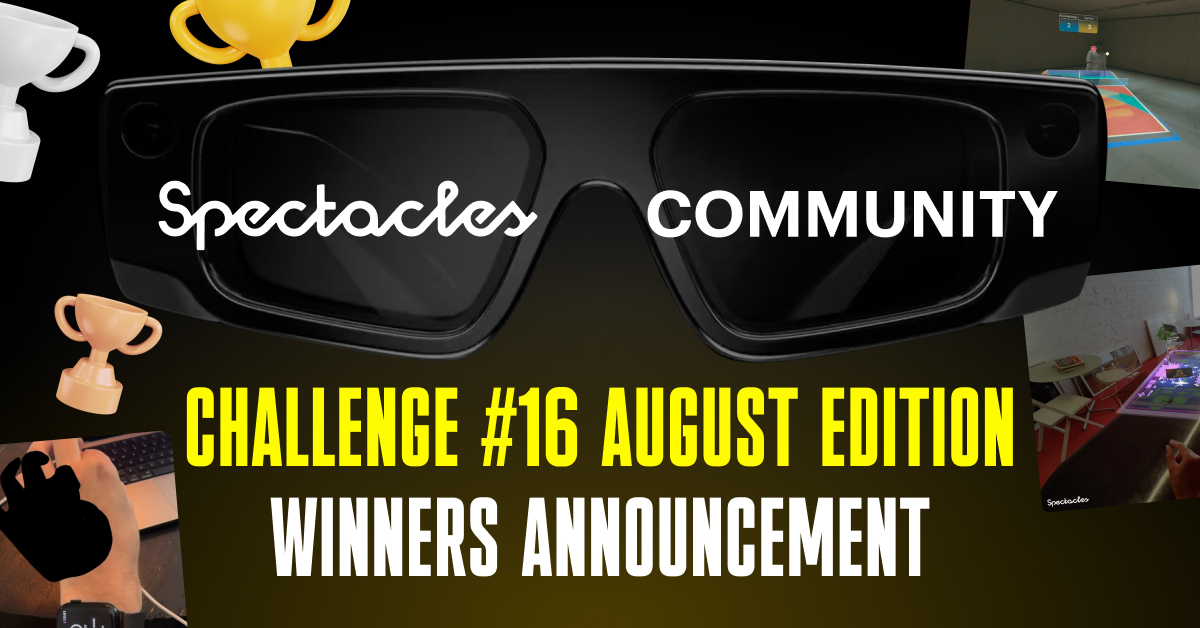
16 months in, and we’re not stopping 🔥 Another round of Spectacles Lenses is here, created by talented developers who continue to explore, build, and push the possibilities of spatial computing.
Together, these experiences show what makes Spectacles unique: a platform that doesn’t replace reality with digital content, but brings the two together in one cohesive world. From productivity and entertainment to gaming, creativity, and education, each Lens explores a different way spatial computing can become part of the world around us.
Huge congratulations to all the winners, and thank you to everyone who submitted their Lenses!
Explore the winners of Spectacles Community Challenge #16 ⤵️
❗P.S. Click on any Lens tile to open it and try it yourself!
New Lens Category
⭐ A category that pushes you to experiment with unfamiliar tools, features, and ideas, turning curiosity into innovation to create new, engaging Lenses.
 1st Place: Plane Spotter by Shahwali Shayan
Plane Spotter turns London Heathrow Airport into a live tabletop AR model powered by real aviation data. Users can watch actual flights arrive, taxi, park, queue for departure, and take off, then point and pinch at aircraft to open Spotter Cards with flight details, routes, aircraft types, and facts. Real-time weather, runway effects, and a detailed Terminal 5 model make the airport feel like a living system unfolding in miniature.
 2nd Place: ArtGuide by Natasha Gubernov
ArtGuide turns Spectacles into an interactive toolkit for artists, bringing digital references and guidance directly onto real paper, canvas, or walls. Users can overlay 30 composition and design guides, upload images to trace, generate and project 3D still-life references, create reference images on the fly, and receive real-time AI feedback, with a voice tutor providing additional guidance throughout the creative process.
 3rd Place: Asset Forge by Vivek Thakur
Asset Forge turns Spectacles into a spatial tool for creating and collecting digital assets from the world around you. Users can capture real-world textures, generate AI images and 3D models using voice or text prompts, and save everything to a linked personal gallery for easy access and reuse.
 Runner up: QWERTY by Pal Kagrecha
QWERTY turns any desk into a spatial keyboard that connects Spectacles to the screens users already work with. Users can type by pressing virtual keys, pinch-write letters, use voice input, or trigger commands with finger taps, then send the keystrokes directly to a browser, macOS, or Windows as standard keyboard input.
Runner up: DGNS Surf Sessions by Guillaume Dagens
DGNS Surf Sessions turns users’ hands into surfers in a spatial finger-surfing game built for Spectacles. Players can ride seven legendary waves, land tricks, chase barrels, and unlock new surf spots, each featuring its own environment, weather, and soundtrack.
Lens Update Category
⭐ The Lens Update category invites you to revisit and enhance an already published Lenses, adding new features or refinements to unlock monetization and gain extra visibility.
1st Place: Smash AR by the VyuXR Immersive Studios (Viraj Dhuri & Sandeep Rathod)
Smash AR turns any space into a mixed-reality table tennis arena on Spectacles, letting users play without a physical table. Now, players can compete with friends in real-time multiplayer matches, unlock and purchase new rackets and custom tables, and climb the leaderboard to compete for the top spot among their friends.
2nd Place: Big Marble by Steven Wolpe
Big Marble is a spatial multiplayer game where players launch marbles across 3D boards to knock opponents off the edge. The latest update introduces real-time multiplayer with friends locally or remotely, AI opponents, scalable play areas, solo progression, over 25 new boards, and an overhauled deterministic physics system designed for fast, seamless multiplayer matches.
3rd Place: Whenabouts by Liam Mason
Whenabouts turns the world around users into a time-travel excavation game, using real fossil records and AI to reveal creatures, plants, and human history connected to each location. A major update expands it into a full game with 15 unlockable guides, environment-aware life-size portals, collectible cards with rarity levels, solo and multiplayer battles, quests, quizzes, streaks, leaderboards, and a coin economy.
Users can also bury Time Capsules, explore new locations through field trips, track discoveries on a Passport map, and build a Memory Wall of places they’ve explored.
Open Source Category
⭐ This category welcomes open-source Lenses on GitHub, including those using Experimental APIs, giving you the freedom to push boundaries and break new ground without requiring Lens Explorer publication.
1st Place: OpenBand by Baruch Geuze
OpenBand turns an ordinary smartwatch into a discreet wrist-worn controller for Spectacles, providing an alternative when hand tracking isn’t practical. Users can navigate Lenses with three simple gestures: pinch to select, double pinch to go back, and pinch-hold with a forearm roll to scroll or adjust sliders, with haptic feedback confirming each action.
It works alongside hand tracking and integrates directly with existing SIK interactions, allowing users to switch seamlessly between their hands and watch.
2nd Place: AirWeb by Ludovic David
AiRWeb extends web browsing beyond handheld screens by connecting a user’s phone and Spectacles through AR. Users can move their browsing experience between devices, bringing web content from their phone into their spatial environment for a more seamless cross-device experience.
3rd Place: Spatial AI DJ by Elsa Farrokhzadeh
Spatial AI DJ turns the room into a four-deck spatial music interface powered by Magenta RealTime 2. Users can drag glowing pucks through 3D space to continuously shape and morph AI-generated audio in real time, creating sounds on the fly rather than relying on predefined samples or loops.
What’s Next for Spectacles Creators?
From turning live flight data into a tabletop airport and transforming a smartwatch into a spatial controller, to multiplayer games, AI-powered creative tools, and new ways to interact with the web, this round shows just how many directions Spectacles development can take.
And that’s exactly what the Spectacles Community Challenge is about: experimenting with what spatial computing can do, improving what already works, and sharing new tools and ideas that can inspire the wider creator community.
Congratulations once again to all the winners of Spectacles Community Challenge #16🏆 And a huge thank you to every creator who built, experimented, updated, and submitted a Lens this round.
Ready for the next one? Keep building, keep experimenting, and we’ll see you in the next challenge! 👓🔥