From Prompt to SPECS 🕶️ Inside the CLAD Summer Hackathon
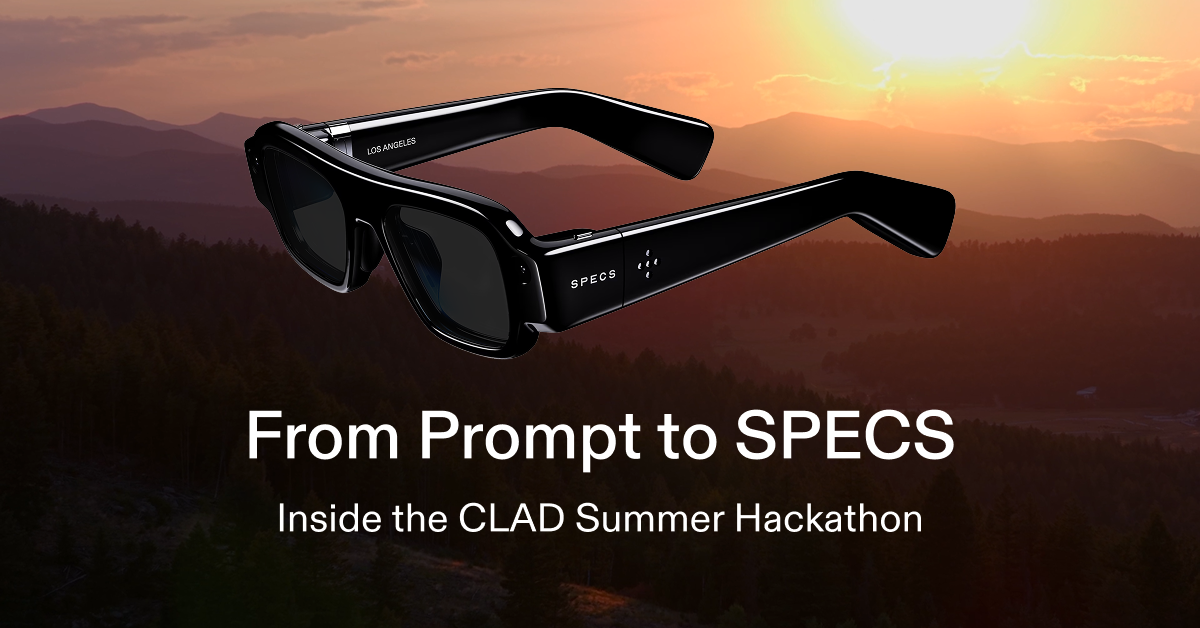
With the official SPECS launch just around the corner, it’s the perfect time to look back at the CLAD Summer Hackathon – a month-long challenge in what it could look like to build spatial experiences for SPECS before the device was even available.
Powered by CLAD, the new AI-driven development workflow in Lens Studio, the hackathon gave creators an opportunity to go from an idea to a working Lens with just a prompt, while exploring how spatial experiences could fit into everyday life beyond the screen.
But let’s start from the beginning 👉 What exactly is CLAD?
What is CLAD?
Closed Loop Agentic Development (CLAD) is a suite of agents and skills that enables AI-powered development in Lens Studio, optimized for SPECS.
In simple terms, CLAD helps you design, build, test, and iterate on Lenses with AI, making it possible to turn an idea into a working experience without having to write every line of code yourself.
So, what does “Closed Loop Agentic Development” actually mean?
🔷Closed means CLAD can build autonomously. A single prompt can be enough for the AI to create a working Lens that matches your request.
🔷Loop means CLAD doesn’t stop at the first version. It can move through design, building, and testing, repeating the process until the experience works as intended.
🔷Agentic means CLAD can break complex tasks into smaller pieces and use specialized agents to handle different parts of the development process.
🔷Development means CLAD acts as your co-developer throughout the process, from writing code and creating visual effects to building 3D elements and more.
In short: you have an idea, you write the prompt, and CLAD helps turn it into a working Lens for SPECS.
No device required. No need to start with advanced coding skills.
You type it. CLAD builds it
CLAD Summer Hackathon: 4 weeks, 4 challenges
The CLAD Summer Hackathon put this new workflow to the test.
Over four weeks, developers were challenged to explore different use cases for spatial experiences, with each week focusing on a different theme. The goal was simple: take an idea, build it with CLAD, and imagine how it could work in a world where information and interactions can exist around you, rather than on a screen.
Each week, developers competed for three prizes: $1,000 for first place, $500 for second place, and $200 for third place.
CLAD launched at AWE in June, so this hackathon was our first real look at how creators would actually use it, from people who have been building in our ecosystem for years to people who had never written code before.
What stood out most was the range of what came in each week, and that none of it required a SPECS device, since everything was built and experienced in the simulator. Spatial experiences like these have historically taken months to build, and week after week the projects were more advanced and more fully realized than I thought possible in that window.
To everyone who built and submitted, thank you for putting your work out there, and if you are reading this and wondering whether you could build a spatial experience yourself, this hackathon proved you can.
— Steven Xu, Developer Relations at SPECS
Week #1 ORGANIZE
The first challenge focused on organising workflows, where the best projects start.
Developers were asked to build a spatial experience that helps people organize, plan, or become more productive, exploring how everyday workflows could be improved when you’re no longer limited to a traditional screen.
Coming up with a cool concept and building it in one week was a challenge, but I was surprised with how fast CLAD could turn my ideas into reality. Now I know that I can quickly build a prototype instead of spending weeks planning ahead.
— Caio Alves, 3rd Place in week #1 of the CLAD Summer Hackathon
Week #2 GUIDE
For the second challenge, we shifted the focus from productivity to assistance.
Developers were challenged to create a spatial experience that guides people through learning, completing, or improving a real-world task.
With CLAD removing many of the technical limitations, I was free to focus on bringing my ideas to life and creating tools I would genuinely want to use myself.
The hackathon helped me immerse myself in product thinking, approach my projects with greater ambition, and ultimately inspired me to keep building.
— Natasha Gubernov, 1st Place in week #2 of the CLAD Summer Hackathon
Week #3 CONNECT
Week three was all about connection.
Developers were asked to build a spatial experience that connects people, platforms, or everyday communication workflows, exploring how spatial computing could change the way we interact with others.
CLAD summer hackathon led me to learn more about CLAD and how I can merge it with my way of building lenses. CLAD altered how I validate my ideas. I generally have one idea but multiple ways for it in my mind, with different features to build into it.
CLAD agents built and validated all the flows I had in one go, and it cleared out the technically impossible ones, and I get to select one that aligns with my vision. Now I can take one idea, look at fifty ways to build it, and know which path is worth committing to before I start. From there it became a loop. Build, test, refine until the lens actually held up.
— Mouleeswarran A, 1st Place in week #3 of the CLAD Summer Hackathon
Week #4 CREATE
For the final challenge, Developers were invited to explore creativity.
The task was to build a spatial tool that helps people create something faster, easier, or more intuitively, showing how SPECS could become part of the creative process itself.
Building for SPECS before SPECS
Experimenting with the new AI workflow in Lens Studio was only a part of the CLAD Summer Hackathon.
Across all four challenges, both experienced developers and creators new to this kind of development were invited to imagine the future of spatial computing – exploring how devices like SPECS could change the way we interact with technology and, ultimately, how they could make our everyday lives easier, more intuitive, and more connected.
All while building without access to the final device.
Especially as a designer without a strong coding background, I feel really empowered to be able to simply explain how I’d like the app to work and have CLAD write all the scripts for me, leaving me with all the fun stuff like UI/UX, game design and 3D!
I noticed that collaborating with CLAD works especially well if we work through the app together step by step, building the rough user flow or game loop first and then going into detail.
It helps to know how you’d build it yourself, so you can explain exactly what you want and also understand the outcome in the end.
It’s impressive how CLAD understands the Lens Studio environment and knows exactly what is needed to finish the request!
— Ines Hilz, 2nd Place in week #1 of the CLAD Summer Hackathon
And that’s what made the hackathon especially exciting: developers were among the first ones to define what building for SPECS could look like, even before the official launch. That way, the platform is ready for users to experiment with the device through the high-quality spatial experiences designed for everyday use.
With devices like SPECS, the screen is no longer necessarily where the experience lives. Your surroundings become part of it. Your hands, your voice, your environment, and your attention can all become part of the interaction, while you stay focused on the real world.
The SPECS launch is almost here. And thanks to the creators who took part in the CLAD Summer Hackathon, we already have a glimpse of what might be possible.
🕶️ Watch the SPECS Launch livestream on Wednesday, September 16 at 4:00 pm PT.