Developer Spotlight: Sitan Doucara on Building the Next Generation of Spatial Experiences
Technology is evolving fast. Every new device, platform, and feature brings an opportunity to develop new skills, explore unfamiliar territory, and play a role in shaping not only how technology works, but more importantly, how we interact with it. And Developers are at the forefront of that change.
Developers like Sitan Doucara are constantly experimenting with different platforms, building experiences that keep users engaged. Whether it’s practical solutions that make everyday life easier or entertaining games that people want to return to, each project is an opportunity to explore what’s possible with emerging technologies.
We spoke with Sitan about her experience building across different platforms, what keeps her motivated to experiment, how she approaches new technologies, and the role creative challenges and hackathons play in her development journey.
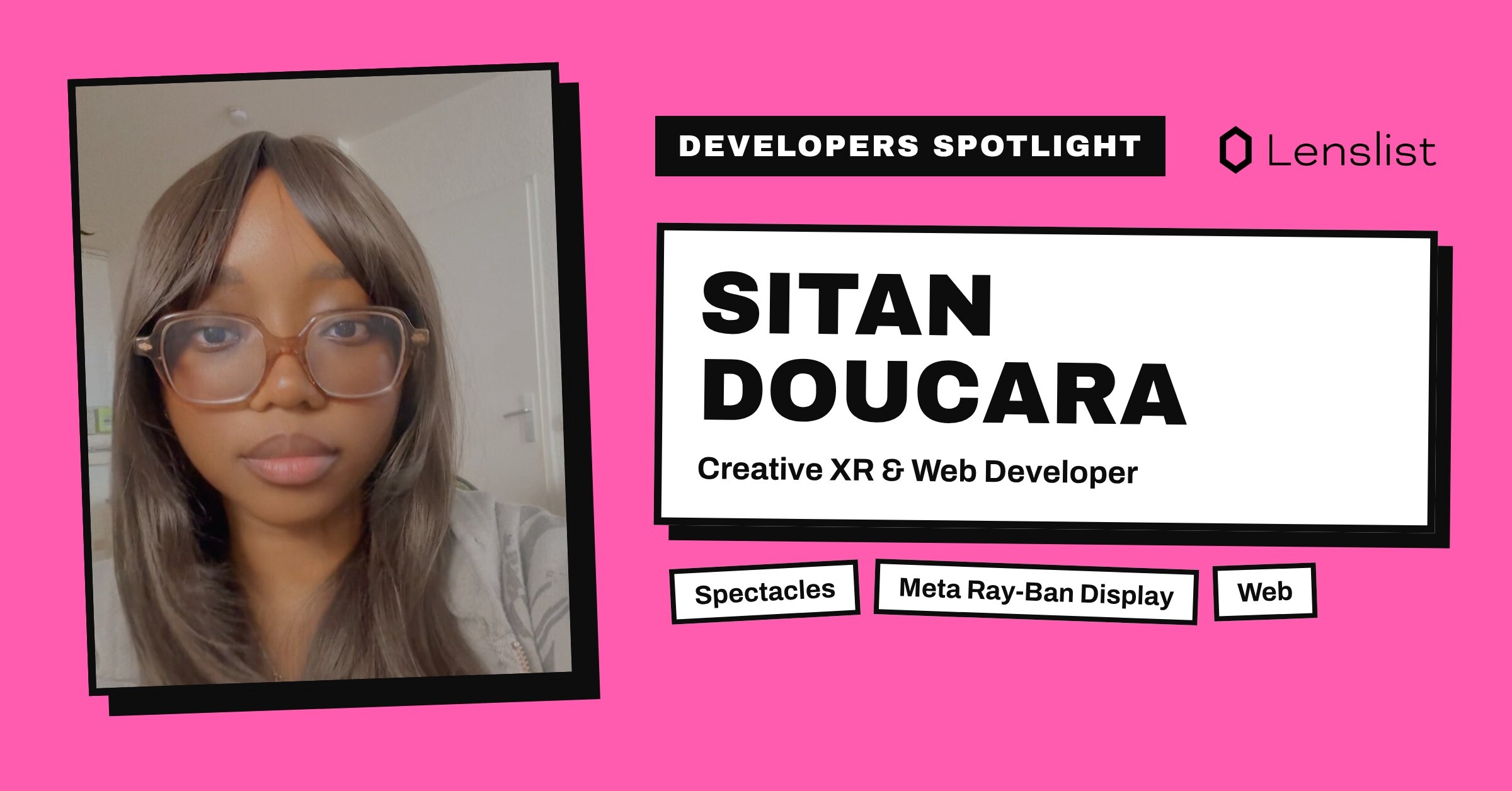
Hi, my name is Sitan Doucara. I’m a Creative XR and Web Developer based in Paris. I build experiences for Snap Spectacles, Meta Ray-Ban Display, and the web.
How does designing for smart glasses differ from phones or computers, and how do you decide what information belongs on each device – or needs no screen at all?
However, building for glasses changes a lot in how those principles are applied. On a phone or computer, you have very clear boundaries — you know exactly where the screen begins and ends. With glasses, and especially with SPECS, the user is moving through the world and the elements move with them.
It completely changes the way you think about space and interaction. Color is one of the first things I had to rethink.
Something that works perfectly well on a screen can be much less readable on glasses. You have to consider transparency, contrast, lighting, but also the real world behind the content. Interactions and gestures also require a different approach.
What I love most about glasses is that the experience feels more like it’s part of the real world. The digital content no longer lives only inside a screen — it exists within the user’s environment. I think that completely changes the way you design and experience something.
How has building Custom Studio for SPECS with CLAD and Claude Code changed what you can create as an individual developer? Has agentic development made you more willing to tackle ambitious projects?
Custom Studio is a good example. I built it in about a week for the CREATE challenge of the CLAD Summer Hackathon, and without CLAD, it would have taken me much longer. Whenever I started with an approach that wasn’t working the way I wanted, I could quickly understand the problem, try something different, and keep moving forward.
Since I started using CLAD, I also think I’ve allowed myself to be a little more technically ambitious with the projects I imagine. Even when I don’t immediately know how to approach an idea or a feature, I can use it to find a starting point, test an approach, and see how far I can take it.
That extra time also allows me to experiment more, add small features I might not otherwise have had time to explore, and most importantly, spend more time focusing on the creative side of the experience.
You’ve participated in several hackathons and challenges. What keeps you coming back? Is it the opportunity to experiment, the community, or something else?
The deadline also plays a big part. It gives me that extra push to make decisions, keep moving forward, and most importantly, turn an idea into something real instead of simply leaving it aside.
What can developers learn from experimenting across different emerging platforms rather than focusing on just one?
Moving to SPECS was a much bigger shift. At first, my instinct was sometimes still to think as if I were designing a traditional interface, and I quickly realized that this approach didn’t always translate. I had to think more spatially and pay more attention to the environment around the user.
Every platform has its own possibilities and constraints, and I think moving between them helps you question some of the habits you develop over time. You learn new ways of creating, and you eventually bring those lessons into future projects, even when they’re built for completely different platforms.
If there were no technical limitations, what would you build for the next generation of smart glasses?
There would be a 3D world layered over the real one, with a map guiding the user to different locations. Each location could unlock a challenge, puzzle, or mini-game, and completing it would reward you with an artifact to collect. The goal would be to gradually complete the entire collection.What I like about this idea is that the glasses wouldn’t take you away from the real world. Instead, the experience would give you a reason to go outside, walk around, and explore different places while discovering a digital world that only exists through the glasses.
It would be a bit like turning the real world into a life-sized video game.
Big Possibilities Start with Small Experiments
In the tech space, developers like Sitan show just how much there is to explore, experiment with, and create. Each new platform makes it possible to build all kinds of unique spatial experiences, from practical everyday tools to imagining entirely new ways of interacting with the world. Every project is an opportunity to learn something new and learn what’s really possible.
And as Sitan’s journey shows, you don’t need to have everything figured out before you start. Sometimes, all it takes is an idea, a willingness to experiment, and a challenge that gives you the motivation to bring it to life. Who knows? Your next experiment might turn into something much bigger than you initially imagined.