Developer Spotlight: Haval Zebari on AI-Assisted Workflows, Hackathons, and Building for Spectacles
Not everyone can become a developer. And it’s not just because of the technical skills the job requires. Succeeding in the industry also takes a particular mindset – one that goes beyond coding.
It’s about having an open mind. Developers like Haval Zebari look at new technologies and immediately see the bigger picture.
They recognize their potential and approach them with curiosity and creativity, understanding how different technologies can complement one another. More importantly, they know how to turn these possibilities into experiences that feel seamless, intuitive, and genuinely engaging for users.
Drawing on his experience not only participating in creative challenges but also winning them, Haval shares his insights on the industry, his experience with AI-assisted workflows, and what changes when you move from building smartphone-based AR experiences to designing for spatial hardware like Spectacles.
You built both of your winning experiences end-to-end with CLAD. How did CLAD’s AI-assisted workflow shape your approach to building for Spectacles? Did it help you explore ideas or technical solutions faster?
CLAD changed the size of the ideas I was willing to try. Before, I would usually choose ideas I knew I could finish in time. With an AI-assisted workflow, I could start with the risky idea and find out quickly whether it would work. What made CLAD different from a general AI tool is that it already understands Spectacles: its skills and agents know the Spectacles Interaction Kit, Sync Kit, and how Lens Studio projects are structured, so I spent my time on the experience, not on explaining the platform.
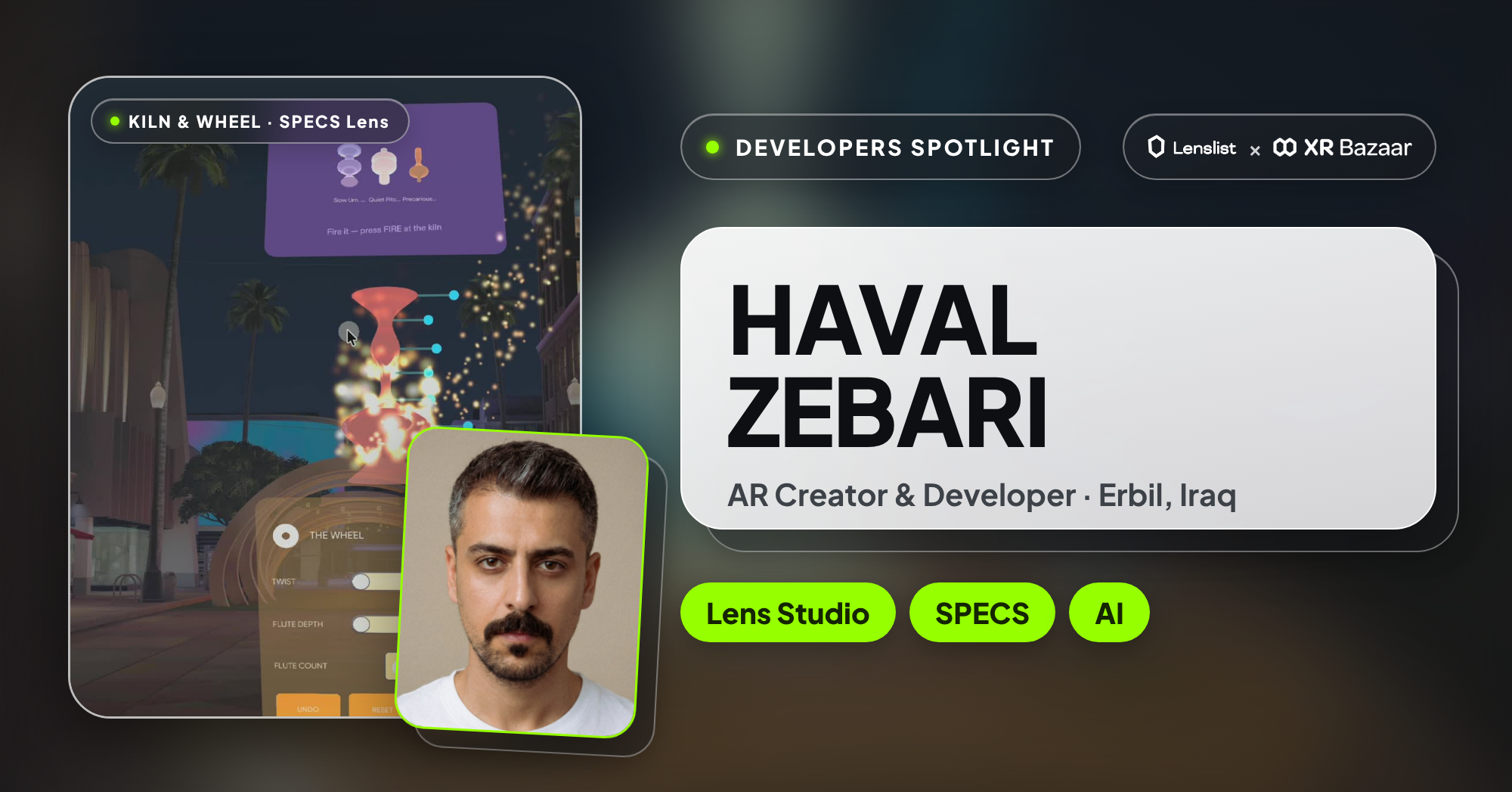
In Kiln & Wheel, the pot is generated live as you pinch and shape its silhouette, and any finished piece can be exported as a QR code that opens a web page where you can download it as a 3D file.
In Relay, two people share a live work queue through Sync Kit, connected to a real database, with Gemini sorting incoming tasks and translating them into six languages. Working alone, each of these features could have taken me a week of research. With CLAD, I built and tested all of them within the same week.
The biggest change wasn’t speed, though. My role moved from writing every line to directing and verifying. I sent more than 150 prompts on Kiln & Wheel alone, and many of them were me checking or questioning what the AI told me. At one point it concluded that the Lens Studio Preview had no depth support at all.
I had seen other projects using it, so I pushed back, and the claim turned out to be only partly true. I also learned that a button that looks broken is usually an empty handler, not a hit-target problem. I kept every lesson like that in a CLAUDE.md file, so each new session started from what we had already learned.
So yes, AI let me explore ideas that would have taken much longer otherwise. But deciding what actually works is still the developer’s job.
What’s your take on hackathons as a way to explore platforms like Spectacles? Do constraints like deadlines, themes, and specific technologies encourage experimentation? What do these events offer that a regular development cycle doesn’t?
For me, the constraints helped more than limited me. Each week had one theme and a hard deadline, so there was no time to overthink: decide, build, ship. We also knew the judges would review everything inside Lens Studio, not on the glasses. That meant designing for a device I couldn’t wear and still proving that every interaction worked.It pushed me into automated interaction testing with LEAF, which I probably wouldn’t have tried in a normal project. I also added a constraint of my own: pinch only. If the whole experience works with one gesture, it’s easier for people to use and easier to trust.
Honestly, my first week didn’t go well. I didn’t finish my project, and I found out someone else was building almost the same idea. That changed my approach for the rest of the Challenge. From then on, I looked for ideas that only I would build.
What these events give you that a regular cycle doesn’t is a finish line. In a normal cycle, a project can stay “almost ready” forever. Here I had to ship everything: a demo video, a README, a public repository. Pathfinder, Relay, and Kiln & Wheel were the first public repositories I ever published on GitHub, and that alone made it worth it. Seeing what other developers built each week also taught me as much as the documentation did.
You created two very different Challenge experiences, from a spatial ceramics studio to a shared work queue. What inspired these ideas?
For “Connect,” many ideas for glasses are about social sharing. I wanted something from real work instead: the moment one person hands a task to another.In Relay, two people see the same queue in their space. A card’s height shows how urgent it is, its distance shows how old it is, and its colour shows who owns it. When you pinch to claim a card, it disappears from your partner’s view, so there’s never any confusion about who is working on what. I added Arabic and Kurdish among its six languages because teams often work across more than one language, and that is something I see around me every day.
For “Create,” the idea came from home. I live in Erbil, often described as one of the oldest continuously inhabited cities in the world, in the northern part of ancient Mesopotamia. Pottery is one of the oldest stories of this land. More than six thousand years ago, potters in Mesopotamia were shaping bowls and jars on slow-turning wheels and painting them with their own designs.
Later, in the Uruk period, the fast wheel allowed specialist potters to produce vessels in large numbers. Many scholars believe the potter’s wheel was first developed in Mesopotamia; a stone wheel found at Ur, in southern Iraq, is around five thousand years old, and archaeologists are still studying how the wheel emerged at sites here in the Kurdistan Region.
Clay was part of everything in Mesopotamian life: homes, trade, and even writing, which was pressed into clay tablets. That history led me to a simple question: what does the potter’s wheel become on a device that didn’t exist until now?
In Kiln & Wheel you shape a pot on the wheel with a pinch, glaze it, and fire it in the kiln, where a bit of randomness makes every piece come out slightly different, just like real firing. You can even hum into the microphone to give the pot its first shape, and Gemini gives every finished piece its own name. One of humanity’s oldest tools, rebuilt for one of its newest devices.
The two projects look very different, but for me they share the same idea: something that exists in your space and that you shape directly with your hands.
What skills from your previous work have helped you design spatial experiences? Has building for Spectacles changed how you think about interfaces and interactions?
Spectacles changed a lot of that. The display is additive, so black becomes transparent and dark colours almost disappear. In Kiln & Wheel I had to design a colour palette for the glazes and the interface that stays visible on the glasses, and I made all the text much bigger than I first expected. On a phone you control the whole frame. On glasses you share it with the real room.
It also changed how I think about interfaces. In Relay I didn’t want a flat list floating in front of you. The space itself carries the information: height, distance, and colour, so position becomes part of the interface. Designing for pinch only taught me to remove steps instead of adding buttons. Every control has to earn its place.
What changes when you design an experience for glasses instead of a phone?
That changes a lot. You design for short glances, not long sessions. The interaction has to be simple, because the user isn’t holding anything. Text and colour follow different rules, because the real world is your background. Placement matters too: in Kiln & Wheel, you can take a fired pot from your shelf and set it down in your room. On a phone, that same pot would just be an image on a screen.
What surprised me was that the phone didn’t disappear. In both projects it became a partner. In Relay, a companion web page sends new tasks into the shared queue, and in Kiln & Wheel, a QR code takes your piece to your phone as a 3D file you can download or print. For me, the glasses are where you do the work, and the phone is where you take the result with you.
How Do Devices Like Spectacles Make Us Rethink the Development Process?
Building spatial experiences for devices like Spectacles means rethinking the entire interaction process from the ground up. As a developer, you need to stop and ask yourself: How do people interact with this technology? How does it differ from what they’re already familiar with? It’s about moving beyond screens, exploring natural gestures, and making physical space part of the experience.
As Haval’s projects demonstrate, spatial computing encourages developers to experiment with new forms of interaction, use physical space as part of the interface, and rethink how different devices can work together. AI-assisted tools like CLAD make it easier to explore these possibilities, test ambitious ideas, and bring them to life.
Ultimately, it’s about more than learning a new platform. It’s about embracing a different way of thinking about technology and interaction, and reimagining the experiences we can create when digital content becomes part of our physical surroundings.